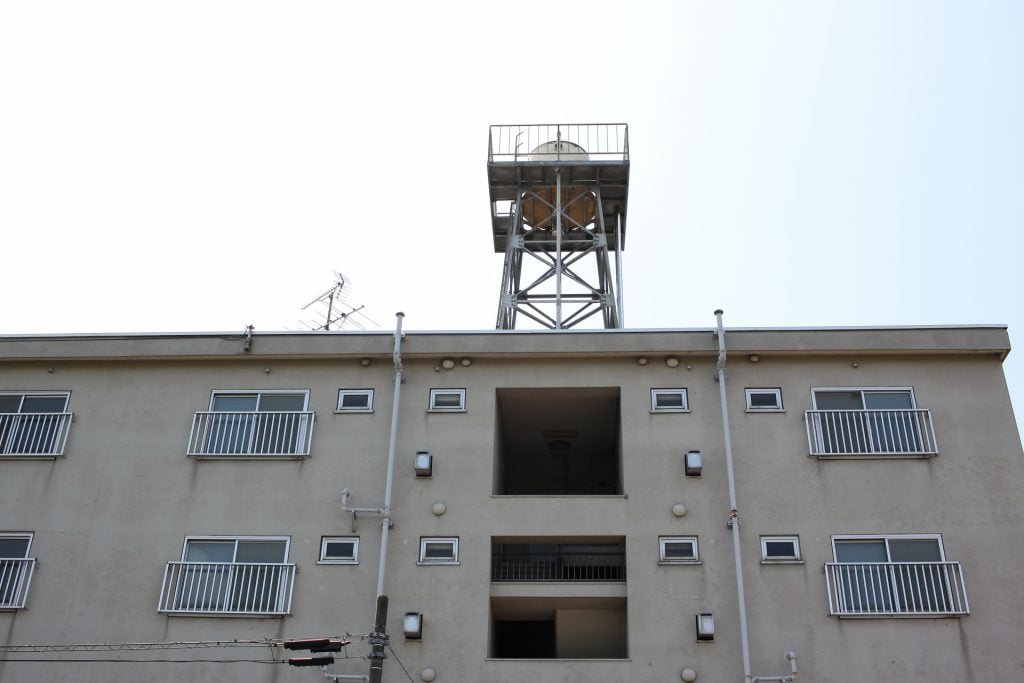
There was a water outage in the apartment building where I live. It was due to the cleaning of the water storage tank. The water was shut off for the entire day. So, in this post, I’d like to write about water outages and water storage tank cleaning.

Water Tank Management Requirements for Building Managers
Under the Waterworks Act, the owners and managers of water storage tanks with a capacity exceeding 10 tons are required to perform maintenance, including cleaning the tank and conducting water quality tests, at least once a year.
Apparently, this is what the law stipulates. Even if the capacity is less than 10 tons, if there is a water storage tank, it must comply with this law. Tanks exceeding 10 cubic meters are treated as “simple dedicated waterworks,” so water quality must be maintained at a certain standard. Our apartment complex does this about once every six months. If this requirement is not met, the installer or manager may be subject to a fine of up to 1 million yen.
Key Points
Most buildings with water storage tanks are legally required to maintain water quality at a certain standard.
5 Checkpoints for Water Tank Inspections
・Cleanliness of the area around the water storage tank... Is there any litter or debris scattered about? Is the surrounding environment clean?
・Condition of the water tank itself... Are there any cracks? Are there any signs of deterioration?
・Condition of the water tank’s outer walls: Check for signs of deterioration; ensure no light is penetrating from the outside
・Condition of the water tank’s interior walls: Check for dirt or foreign objects
・Check for leaks from the water tank... Check for any ingress of rainwater or sewage from the outside
They reportedly check these points.
Then they clean it. Wearing full-body protective suits, they scrub the tank with sponges. After rinsing it thoroughly, they disinfect the interior twice with chlorine (sodium hypochlorite).
This ensures the water is clean and safe to use. Thank you to the professionals for your hard work.


However!
With a two-tank system, there’s no water outage during tank cleaning
Really?! That’s amazing!
It must be a new, high-end apartment building. Not a run-down place like ours...
No water outage! How wonderful is that? You don’t have to go a whole day without water or use bathwater to flush the toilet.
With a two-tank system, you can use one tank while the other is being checked and cleaned, so there’s no need to shut off the water.
Key Point
In apartment buildings with two or more water storage tanks, there is no water outage during cleaning. However, cloudy water may come out of the tap after cleaning.

The Tragedy After the Water Shut-off
Once the water tank cleaning is successfully completed, the water supply is turned back on. That’s when the tragedy strikes.
We’ve seen this happen before: some residents leave their faucets running while they go out during the water shutdown. With single-lever faucets, it’s easy to forget whether you turned them off or left them on. Once the water is restored, a massive amount of water gushes out, flooding the room and causing water to drip down to the floor below—and even further down. If no one is home, we’re sorry, but we have no choice but to shut off the main water valve for that unit.

Important Note
When leaving home during a water outage or water tank cleaning, be sure to check that the water supply is turned off before you go.
Don’t use the toilet first
Apparently, you should not use the toilet immediately after water service is restored following a water outage.
If you use the toilet first, or if the tank is empty, when water service is restored, water mixed with sand and mud will be flushed out all at once, causing the toilet strainer to clog.
A strainer is a mesh-like device attached to the water pipe that removes foreign objects. Additionally, debris can also clog the check valve—a component designed to prevent backflow, found in fixtures like mixer taps that combine cold and hot water.
In fact, yesterday I went into the bathroom during the water outage and, out of habit, accidentally flushed the toilet. Habits are scary, aren’t they? Even though I knew in my head that the water was off, I still ended up doing it. As a result, after the water was restored, the toilet made a gurgling sound—probably because air got trapped inside. This can also damage the water pipes.
It seems best to first let the murky water run in the sink, bathtub, or kitchen before using the toilet.
Point
After cleaning the water tank, be sure to first let the cloudy water run out in the sink, bathtub, and kitchen.
Summary
In high-rise buildings with water storage tanks of 10 tons (10 cubic meters) or more, inspections and cleaning are required at least once a year. For single-tank systems, this frequency will result in a water outage. For dual-tank systems, inspections and cleaning can be performed without a water outage. During a water outage, you must be careful to ensure that the water supply is properly shut off. Also, it is best to avoid using the toilet immediately after the water is restored. It is recommended to first let the cloudy water run out completely in the kitchen and bathroom sinks.
よろしければ応援お願いします


Reference Site


